The health angle
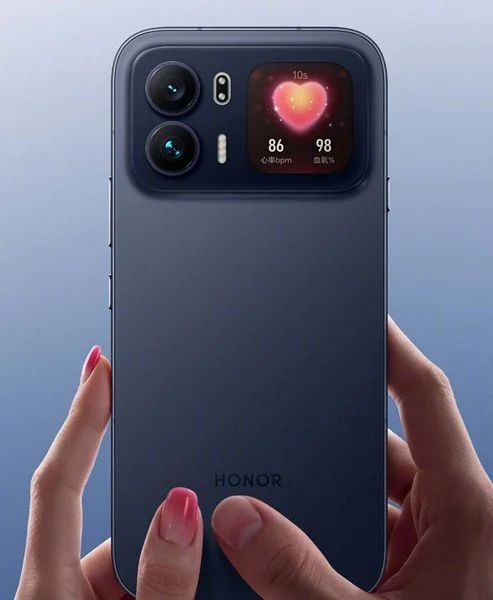
Honor's rear screen is picking up a health angle, and that's the part worth watching. Teasers for the Honor 700 series show the back display reading a wearer's heart rate and blood oxygen, a trick you'd normally expect from a smartwatch. That's an odd place for it. Phones have spent years getting thinner and more uniform, and a back panel that doubles as a pulse readout pushes in a different direction. Wrist wearables have owned this category for a while, so a phone that can handle even a rough version changes who needs what on their arm.
The first details came from the leaker Digital Chat Station, who posted them on Weibo. The list is long and mostly unverified: a 6.5-inch front display with extremely thin bezels, a 200MP camera, and mini-games and "dynamic notifications" on the rear screen. There's also an "industry-exclusive" feature that's unclear in machine-translated form, which is its own kind of frustrating. The health readout is the only item on that list that has actually been shown. Everything else is still a claim.
Honor hasn't explained how the rear panel gathers this data. The working theory is an in-display sensor doing the job a smartwatch's optical sensor does. That's plausible, but it's still a theory. (and this is the part most people overlook) Reading pulse through a phone's back panel would be a real hardware feat, and accuracy on a moving wrist is a different problem from accuracy on a phone sitting on a desk. A demo rarely tests either, so the implementation will matter more than the teaser.
Rear screens are spreading
Xiaomi's 17 Pro series already ships with a rear display. Honor's version looks a little smaller, which suggests it's aiming for a narrower role than a full secondary screen. Here's the thing: a small rear panel that only handles notifications and fitness readouts is a practical design, not a gimmick, as long as the readings are accurate. Full secondary screens ask a lot of the user and the battery. A smaller one asks for less, and that's a more honest pitch.
Secondary screens on phones have been tried before in various forms, and they tend to live or die on whether anyone looks at them daily. A rear display that shows a heart rate you'd otherwise have to pull out a watch to see is a clearer daily use case than a second panel for scrolling feeds. That said, usefulness on paper doesn't guarantee habit.

A fast follow-up to the 600
Honor launched the 600 series in April, and the 700 is arriving only months later. That's a short gap, and it tells you something about how Honor is pacing itself. Phone makers in this price band tend to wait a full cycle between refreshes, so a faster turnaround reads as deliberate. The 600 and 600 Pro both use a 200MP primary camera and a 12MP ultrawide, with the Pro adding a 50MP telephoto. The base model runs Qualcomm's Snapdragon 7 Gen 4, while the Pro uses the Snapdragon 8 Elite.
Expect the 700 lineup, which includes the 700, 700 Pro, and 700S, to follow that split. Specs are still unconfirmed, and they could differ by model. That said, a quick refresh on a mid-range line suggests Honor wants to keep pressure on rivals rather than wait a full cycle. If you're weighing these, don't lock in on the 700 name alone. The tiers are where the real differences tend to show up, and the rumored split will need confirmation before it means much.
What this means for the rest of the market
If the rear display works as teased, it becomes a feature rivals will need an answer to. Not immediately, and probably not with the same implementation. Still, once one maker shows a useful secondary readout, competitors tend to follow within a product cycle. That's how most features spread in this industry, and it's why this matters beyond Honor's own sales. The bigger question is whether the health readings can survive contact with real users, not just a stage demo.
There's also a trust question. Health claims on consumer hardware carry more weight than a fun notification trick, and a wrong reading is worse than no reading at all. I'd expect Honor to hedge with caveats and point users toward proper medical devices for anything serious. Nothing in the teaser suggests how it'll word that, though, and the wording will tell you a lot about how confident the company really is.
Where I land
The base 600 didn't grab me, but the Pro did. Mid-range phones rarely feel exciting, so a distinctive feature could be what sets the 700 apart. If the heart-rate readings hold up outside a demo, that's a reason to pay attention. I'd say this is more significant than it looks, because it's one of the few mid-range ideas in a while that isn't just a bigger battery or a sharper camera. Interesting. Not yet proven.
The catch is price. RAM and memory shortages are squeezing the market, and mid-range phones are not immune. Cheaper devices feel these costs hardest because there's less margin to absorb them. If Honor passes those costs along, a useful rear display won't be enough. The number to watch is the price tag when the series debuts in China on November 13.