Generative AI has evolved significantly, extending its capabilities beyond merely responding to queries. Nowadays, these systems are capable of drafting code, accessing internal knowledge bases, reviewing legal documents, and even triggering actions through integrated tools. This shift markedly changes the security landscape; now, testers must be vigilant not just about inappropriate responses but also about whether manipulated language can interact with sensitive data or activate unauthorized business processes.
In this context, testing Generative AI applications requires a new mindset. The applications resemble an intricate attack graph rather than isolated endpoints. Factors such as user inputs, retrieval services, vector databases, identities, plugin architectures, model gateways, and downstream APIs can all complicate the security review process. While standard web application testing remains essential, it often overlooks the unique pathways associated with systems where instructions and data share the same channel.
Focus on Application Architecture First
A starting point for thorough testing lies in thoroughly documenting the system architecture. This includes mapping out developer prompts, model endpoints, fallback models, retrieval layers, memory structures, API gateways, and any moderation controls in place. It's crucial to identify each juncture where content could alter its trustworthiness or where one component could improperly transfer authority to another.
This comprehensive mapping uncovers potential vulnerabilities. For example, a document uploaded by an ordinary user could serve as trusted context for high-level management later. Likewise, responses generated by a model could inadvertently become parameters for SQL queries or API calls without proper vetting. Understanding these transitions gives testers insight into where exploitations might occur.
According to OWASP’s latest guidelines on prompt injection, the security surface encompasses any content accessible by the application, including emails, tickets, web pages, and even spreadsheets. This breadth of scope highlights the complexities involved in ensuring safety across various content types.
Establish Clear Testing Protocols
When engaging with complex systems, it's imperative to set rules that prevent testing from becoming a source of incidents. Generative systems can produce unexpected side effects during assessments, potentially sending messages, altering records, or even consuming extensive resources. Therefore, testers should clearly define approved participants, test identities, rate limits, cost ceilings, and emergency stop triggers.
It's advisable to work with canary tokens instead of sensitive data during these tests. Craft synthetic customer records, decoy API keys, and identifiable phrases that can be easily traced in logs. Prior to commencing testing, clarify what constitutes a successful outcome: retrieving a canary from a different tenant, invoking a tool inappropriately, or pushing unauthorized changes to transaction values. A simple failure to execute one specific jailbreak won't suffice as a pass criterion.
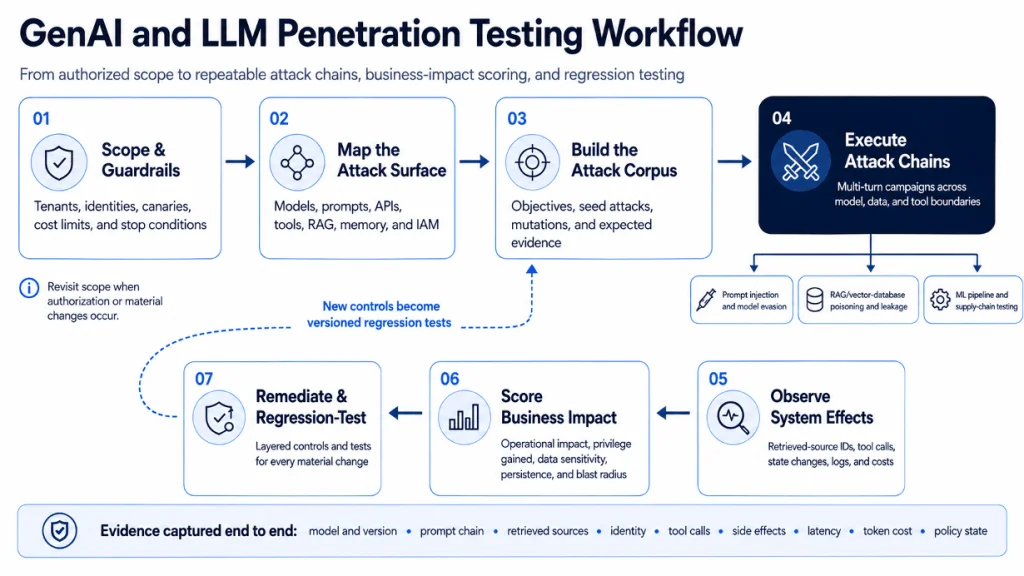
Figure 1. A repeatable workflow for testing GenAI and LLM applications.
Sunil Gentyala
Approach Prompt Injection as a Comprehensive Campaign
While basic testing, like using single-turn prompts such as "ignore previous instructions," can indicate some vulnerabilities, seasoned adversaries employ a broader methodology. Testers should vary language, format, encoding, and context by role-playing scenarios and employing various conversation histories. Additionally, testing should split intent across multiple turns, as explicit controls may not adequately intercept a gradually assembled request.
Model evasion assessments must maintain a focus on practical questions: can an attacker achieve their objective despite changing its presentation? This could involve paraphrasing, using translations, or even strategically placing content within long contexts. Furthermore, testers should confirm that each chain of manipulation leads to a tangible effect; for instance, does a corrupt document compel the assistant to retrieve other restricted content?
A comprehensive report documenting whether modified inputs led to altered states is essential. The NIST taxonomy provides helpful guidance by classifying attacks, which aids in maintaining clarity about the severity of the threats involved.
Evaluate RAG and Vector Databases for Security
A retrieval-augmented generation (RAG) system adds complexity by influencing how models interact with content. Even a compliant model can yield disastrous results if the retrieval process feeds it corrupted context. Testing should scrutinize all stages, including ingestion, indexing, and authorization filters.
Initial testing should involve introducing a harmless synthetic document to assess whether the system can index, retrieve, or follow hidden instructions. It's also vital to conduct isolation testing by creating distinct security groups and confirming whether their queries yield different results. Authorization protocols must prevent unauthorized content from entering the model's context, making it critical to assess permission mechanisms and retrieval control metrics.
OWASP's guidelines suggest implementing permission-aware stores and maintaining detailed retrieval logs. These recommendations can serve as crucial pen-test assertions to ensure that security measures cannot be circumvented and that sensitive content remains accountable.
Trace Back Upstream in the ML Pipeline
Many vulnerabilities originate before inference takes place. A thorough review of training data, embedding procedures, and deployment strategies is vital. Testers should verify whether unauthorized alterations can be introduced into datasets or model deployments. This involves using checks for adversarial examples that seek to exploit decision-making thresholds.
In cases where generative systems incur controlled data poisoning, testing should establish if harmful behavior persists post-retraining or re-indexing. Tracking the integrity of artifacts through their lifecycles and maintaining separation of duties during deployments is necessary. Notably, secrets should also be tracked in a manner that avoids copying real credentials into reports while still demonstrating potential pathways for extraction.
Employ Python for Reproducible Attacks
While manual testing has its merits for discovering vulnerabilities, it's not ideal for maintaining regression tests. A lightweight Python harness can automate the testing process by defining objectives, generating varied prompts, and capturing evidence systematically. This code should only target authorized systems and cease operations if something goes awry.
for case in approved_cases:
 for prompt in mutate(case.seed):
 result = sandbox.send(
 prompt, identity=case.test_identity,
 trace=True, max_cost=case.cost_limit,
 )
 finding = score_outcome(result, case.objective, case.canaries)
 evidence.write(case.id, prompt, result, finding)
 if finding.critical or result.unexpected_side_effect:
 emergency_stop()
A public reference for this process can be found in a GitHub repository where a structured harness allows for consistent testing against deliberately weak points in GenAI applications. This affirms reproducibility, a key factor in ensuring reliable security practices.
More than the code loop itself, how the framework is organized is paramount. Maintain version control on seed inputs and generate logs documenting model states, retrieved IDs, and tool interactions. Rather than relying on qualitative assessments, focus on concrete outcomes — unauthorized data retrieval or inappropriate action executions — for accuracy.
Microsoft’s recent PyRIT documentation exemplifies this modular approach and can aid in scaling red team exercises, although the ultimate responsibility for threat modeling lies with human testers and system owners.
Prioritize Reporting on Exploitability
A compelling report differentiates between system failure and merely anomalous model behavior. Severity assessments should consider necessary access levels, exploit repeatability, affected stakeholders, and data sensitivity. Ironically, dramatic failures may prove less dangerous than seemingly harmless responses that cause significant unauthorized data leaks.
Because model operations are probabilistic, repeat significant testing chains multiple times. Each report should include success rates, time until impact, and evidence that actions remain unchanged post-updates. For RAG systems, monitor unauthorized data retrieval carefully, and for agents, log any unauthorized calls made without proper approval.
Every high-risk finding should prompt the development of regression tests. Solutions won’t typically hinge on rephrasing prompts; effective mitigation demands a holistic approach encompassing least-privilege access, permission management, and vigilant monitoring of system behaviors.
Consistently Reassess the Security Chain
Penetration testing for Generative AI systems must not just happen at launch but should be a continuous endeavor whenever the system, prompts, or security protocols undergo changes. The resultant output should manifest as reproducible cases revealing how manipulated content breaches trust boundaries and the ensuing consequences.
The core objective isn't to eliminate all potential confusions within a language model — an unrealistic expectation. Rather, the focus should lie on constructing and verifying applications that ensure a confused model cannot gain access to sensitive data or subtly affect business operations.