A healthcare software provider, initially confident in its security measures, discovered critical vulnerabilities that could jeopardize its operations. The company had already invested significantly in layered security controls, including a segmented environment for its distributed workforce, strict management of administrative access, and comprehensive multifactor authentication (MFA) protocols, along with regular vulnerability scanning and annual penetration tests.
However, a recent insider threat penetration test using NodeZero® shattered their assumptions by revealing how swiftly a single compromised developer credential could lead to lateral movement through their network, reaching the cloud infrastructure that supports their software delivery. “It owned our network in a matter of minutes,” stated the organization’s IT operations leader. This wake-up call shifted their focus from merely securing endpoints to understanding the broader implications of a potential compromise, especially given their role in the healthcare ecosystem.
Moving Towards Continuous Validation
The key takeaway for the organization became clear: traditional security checks, such as annual penetration tests and vulnerability scans, didn't adequately address the pressing question: What can an attacker achieve once inside? Recognizing this gap prompted a shift towards continuous validation, frequent testing, and a more proactive stance on exposure management. Continuous validation emphasizes the importance of ongoing assessments over static annual evaluations. This approach allows organizations to identify and remedy potential vulnerabilities before they can be exploited.
Outcomes at a Glance
- Eliminated 16 internal weaknesses that previously compromised four hosts, preventing AWS data exposure.
- Reduced critical AWS vulnerabilities to just two low-severity issues, which could not combine to cause significant harm.
- Eliminated overly permissive local-administrator access after NodeZero showcased rapid lateral movement and privilege escalation.
- Established privileged access approval workflows and enhanced MFA implementation across the board.
- Set up a repeatable cycle of testing, remediation, and validation on a monthly basis.
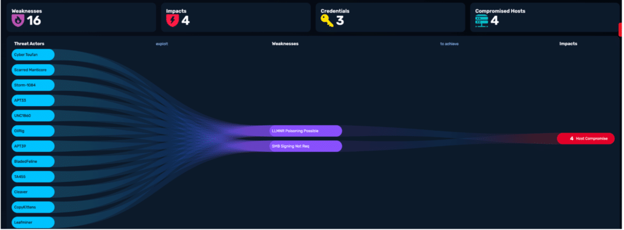
Initial internal testing identified 16 weaknesses compromising four hosts, preventing AWS compromise and sensitive data exposure.
Impact of the Discovery
The security team had previously believed their network was secure, but the reality of what an attacker could accomplish once inside was alarming. Instead of merely identifying isolated weaknesses, they had to consider how those weaknesses could chain together in a real-world scenario. For organizations like this one, characterized by a broadly distributed workforce and significant cloud reliance, the recognition of the limitations in relying solely on traditional testing methods came as a hard lesson. This scenario isn't unique—many companies hold a similar false sense of security.
After their initial experience with NodeZero, the team realized annual penetration tests serve as just a snapshot of system security. “Technology does not stand still. It only changes,” remarked the IT operations leader. Initial attempts at a phishing penetration test yielded no credential entries from employees, which led them to conduct a more realistic simulation. They asked three employees—a developer, an HR representative, and a support staff member—to enter fake credentials, allowing them to observe potential attack trajectories.
This approach quickly uncovered the critical areas of risk. While the HR and support accounts remained secure, the developer account revealed a much wider pathway for breach. NodeZero bypassed their segmentations, cracked password hashes, escalated privileges, and quickly sought access to AWS-connected resources. “We’re completely segmented,” admitted the operations leader, highlighting that they erroneously believed siloing provided sufficient protection. Instead, NodeZero demonstrated how one compromised developer account could serve as a pivotal point for lateral movement, raising questions about the efficacy of segmented networks in practical scenarios.
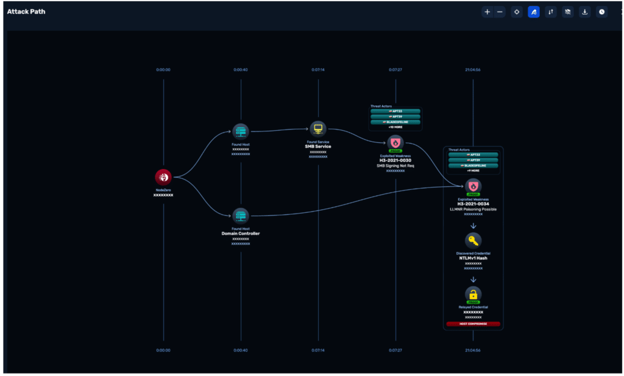
NodeZero illustrated how a compromised developer path could navigate through segmented environments to achieve host compromise.
Click here to explore details surrounding mitigation and remediation efforts.
Ongoing Commitment to Security
“Ultimately, our goal is to make sure our staff has jobs to come to each day,” concluded the IT operations leader. This statement shifted the viewpoint from mere compliance to a continuous obligation to ensure that adversaries can't easily traverse their environment unchecked. No organization can afford to adopt a passive stance on security; complacency invites risk. Ongoing vigilance and adaptation to evolving threats must be non-negotiable priorities.
Implications and Future Outlook
If you're working in this space, the implications of this story are significant. The reliance on traditional testing methods is becoming increasingly tenuous as attackers evolve and exploit new vulnerabilities. This scenario underscores the necessity for continuous security practices over traditional methods that can quickly become outdated. Traditional approaches simply won't cut it anymore in a landscape where attackers can maneuver stealthily.
What's next? Organizations need to rethink their approach. Continuous validation and open channels of communication within teams are essential for realizing a comprehensive security posture. An adaptive security model requires constant re-evaluation of threats, internal processes, and system configurations. It’s not just about fixing vulnerabilities—it’s about anticipating future risks.
For more insights on enhancing cybersecurity, visit Horizon3.ai and NodeZero.